How to play Solitaire
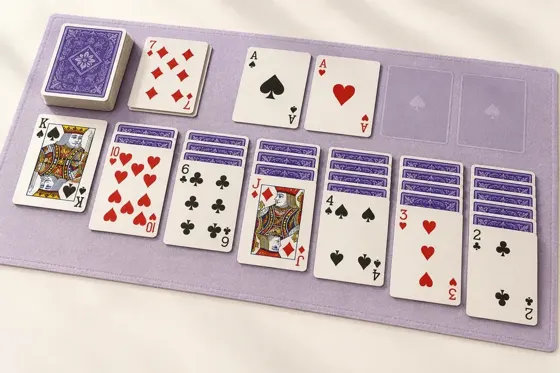
Solitaire uses classic Klondike rules: seven tableau columns, a one-card stock draw and four suit foundations. Reveal hidden cards and build every foundation from Ace to King. Duel mode gives both players the same deal.
Start a game
- Move available cards between tableau columns in descending, alternating-colour order.
- Reveal covered cards as the cards above them leave.
- Draw one card at a time from the stock when needed.
- Build each suit foundation upward from Ace to King.
- Move all 52 cards to the four foundations to finish.
Tableau, stock and foundations
The seven tableau columns begin with one to seven cards respectively; only each column’s top card is face up. Build downward in alternating red and black, such as a red Nine on a black Ten. A valid descending sequence may be moved together.
Only a King, possibly with its attached legal sequence, can fill an empty column. The stock reveals one card at a time. When it is exhausted, the exposed stock cards can be recycled for another pass.
Foundations are different from tableau columns: each is one suit, ascending from Ace to King.
Solo and duel play
Solo play records time and moves so you can work at your own pace. A friend duel uses identical deals and is a race to complete the foundations. Create the duel and share its invitation code or link.
A random Klondike deal is not guaranteed to be solvable. If no useful moves remain, a new deal may be necessary. The shared deal in a duel prevents one player receiving an easier initial arrangement.
Undo, Hint and To foundations
In solo play, Undo reverses the last move, Hint points to an available move, To foundations moves eligible cards upward, and New begins a fresh deal. Read a new-deal confirmation before abandoning your current position.
Do not automatically move every high card to a foundation as soon as it is eligible. A tableau card may still be needed as the destination for an opposite-colour card that reveals another hidden card.
Example: uncover before drawing
If a red Nine can move onto a black Ten and doing so reveals a face-down card, inspect that move before drawing from the stock. It creates new information and may open a chain of useful moves.
An empty column is most useful when a King can occupy it. Clearing a column without any available King may leave you with less working space until the right card appears.
Strategy and useful habits
- Prioritise useful moves that reveal hidden cards.
- Check longer covered columns for opportunities.
- Keep a foundation move’s effect on tableau access in mind.
- Use Undo in solo play to compare different move orders.
Common mistakes
- Building tableau sequences in the same colour.
- Trying to put an ordinary card into an empty column.
- Confusing ascending suit foundations with descending tableau rules.
- Assuming every random deal must have a solution.
Questions and answers
How many cards are drawn from the stock?
One at a time; the stock can be recycled when exhausted.
What can fill an empty tableau column?
Only a King, with any legal descending sequence attached to it.
Can I undo a move?
Yes, Undo is available in solo play.