How to play Push Your Luck
Push Your Luck asks everyone to add to one shared total without exceeding a visible limit. A safe last card wins immediately. An unsafe card sends you to the Wheel of Fate, where each previous failure makes survival harder.
Start a game
- Start a solo game, ranked duel or table with friends. Bots fill empty seats at the four-player table.
- Check the current total, the limit and any pending effect.
- Play one number or action card. Cards are not drawn between turns.
- Stay at or below the limit. Exceeding it triggers the wheel.
- Empty your hand safely, or be the last surviving player.
Cards and effects
- Numbers 0–10 add their face value to the total.
- Reverse changes the direction of play.
- +2 stores a penalty. The next card other than +2 or Block adds two extra points for each pending +2.
- Greater Than requires the next number card to be greater than 3.
- Reset returns the total to zero.
- Randomizer sets the total to a random value from 0 to 20.
- Block cancels the pending special effect and can only be played when an effect is waiting.
Rounds and the Wheel of Fate
Each player starts a round with five cards. The visible limit is between 15 and 30. You play one card on a turn and do not refill your hand.
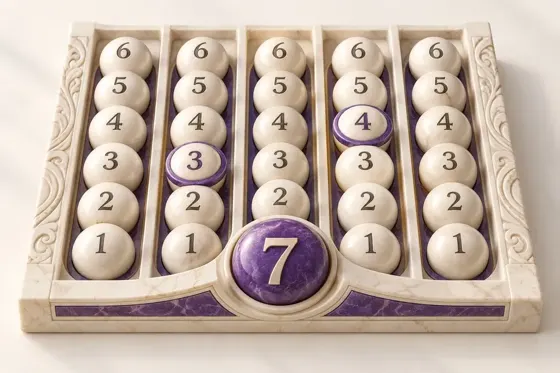
If a play makes the total exceed the limit, its player gains another skull and spins the wheel. The chance of elimination is the number of skulls out of six. A new round resets the total to zero, chooses a new limit and deals fresh hands.
Playing your last card without exceeding the limit wins immediately; the other players must spin. If nobody wins by emptying their hand, the last survivor wins.
Example: hitting the limit is safe
With a total of 18, a limit of 20 and no pending effects, a 2 makes the total exactly 20 and is safe. A 3 makes 21 and triggers the penalty. The rule is to avoid exceeding the limit, not to avoid reaching it.
Always include pending +2 cards in the calculation. A number that would fit on an ordinary turn may become unsafe once that penalty is added.
Plan your last cards
High numbers are easier to dispose of while the total is low. Zeros, ones and twos are useful late, when little room remains. Reset and Randomizer offer a way out of a dangerous total, but spending them too early leaves fewer options.
Ask what your play leaves for the next player. Taking the total close to the limit can force an opponent with high numbers into a difficult decision.
Strategy and useful habits
- Calculate the space remaining before selecting a number.
- Save a reset effect for a difficult total.
- Check pending +2 penalties rather than relying only on the displayed total.
- Adapt your risk to the skulls already on your wheel.
Common mistakes
- Assuming reaching the limit is a penalty.
- Forgetting that +2 is applied with a later card.
- Keeping only high numbers for the end.
- Trying to play Block when no special effect is pending.
Questions and answers
Can everyone see the limit?
Yes. It is visible and is chosen again between 15 and 30 for each new round.
Do I draw after playing?
No. Fresh cards are dealt at the start of a new round.
What happens if my last card is unsafe?
It does not give a safe-hand win. Exceeding the limit triggers the wheel.