How to play Dice
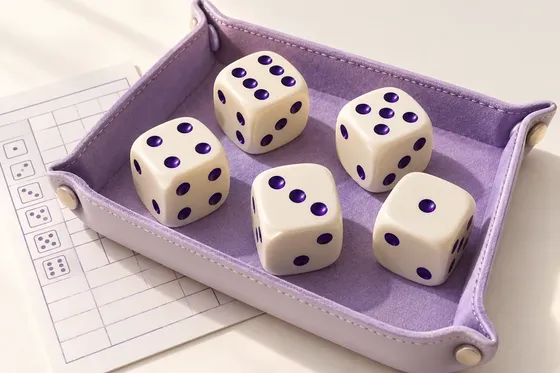
Dice is a thirteen-category game with five dice and up to three rolls per turn. Hold useful dice, choose a scoring category and balance immediate points against the 35-point upper-section bonus.
Start a game
- Roll all five dice.
- Tap dice to hold or release them before rerolling the others.
- Use at most three rolls, or score earlier.
- Choose one unused category; confirm if you intentionally score zero.
- Fill all thirteen categories. The largest total wins.
The scorecard
| Category | Score |
|---|---|
| Ones through Sixes | Sum of dice showing that value |
| Three or Four of a kind | Sum of all five dice when the condition is met |
| Full house | 25 |
| Small straight: four consecutive values | 30 |
| Large straight: five consecutive values | 40 |
| Five of a kind | 50 |
| Chance | Sum of all dice, without a matching condition |
Holding and committing a score
After the first roll, hold the dice you want to keep and reroll the others. You may change which dice are held before the next roll. Three rolls are a maximum, not an obligation: score a useful result immediately if you prefer.
Each scorecard category can be filled only once. The card shows the value available for the current dice. If nothing useful fits, you still need to fill an unused category, potentially with zero. A zero score asks for confirmation.
Upper bonus and repeat five of a kind
A total of at least 63 in Ones through Sixes awards a 35-point bonus. Three of each value would reach exactly 63, but other combinations can also reach the threshold.
Once the five-of-a-kind category is filled, another five of a kind can act as a joker for a full house or either straight. Do not assume an ordinary roll of repeated dice normally makes a straight; the repeat-category rule is a special case.
Example: score the right category
A roll of 5, 5, 5, 2, 2 is a full house worth 25. It can also score 15 in Fives, or 19 in Three of a kind or Chance. The best long-term choice depends on which categories remain and your progress toward the upper bonus.
The match ends when all players have filled thirteen categories. Equal final totals are a draw. Friendly play can make an automatic move after a 40-second timeout; in ranked play a missed move can lose the match, so do not rely on automatic scoring.
Strategy and useful habits
- Track the upper total, not just the current highest scoring cell.
- Save flexible categories for rolls that fit poorly elsewhere.
- Check all unused categories before confirming a zero.
- Score early when another roll is unlikely to improve a valuable result.
Common mistakes
- Thinking three rolls are compulsory.
- Counting only matching dice in Three of a kind instead of all five.
- Using a category that is already filled.
- Forgetting the upper-section bonus.
Questions and answers
How much is five of a kind worth?
50 in its category. A later five of a kind can use the special joker rule.
When do I receive the upper bonus?
When Ones through Sixes total at least 63; the bonus is 35.
Can I score after the first roll?
Yes. You do not have to use all three rolls.