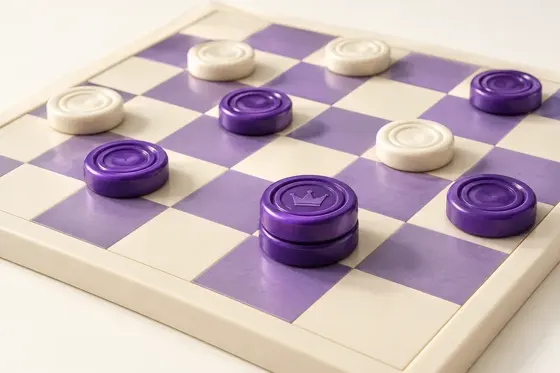
How to play Checkers
This Checkers variant uses an 8×8 board with Brazilian-style capture rules. Men can capture backward, kings fly along diagonals, and you must choose a capture sequence taking the greatest possible number of pieces.
Start a game
- Each side starts with 12 men on the dark squares.
- Select a piece and one of its highlighted destinations.
- Make a capture whenever one is available; follow the longest legal sequence.
- Reach the far row to crown a king.
- Capture or immobilise every opposing piece to win.
Men and flying kings
A man makes an ordinary move one empty square diagonally forward. Captures are different: a man may jump an opposing piece in any diagonal direction, including backward, when the required landing square is free.
A man reaching the last row becomes a king. A king can move any number of empty diagonal squares and capture from a distance, landing on a legal empty square beyond the captured piece.
Compulsory longest captures
If a capture exists, an ordinary move is not allowed. If several capture sequences exist, choose one taking the most pieces. The highlighted moves help show which options are legal.
Count the whole sequence before selecting a tempting single jump. Captures can create forced replies: sacrificing a man may force the opponent onto a square from which you can capture several pieces.
Winning, draws and the clock
You win when your opponent has no pieces or no legal move. A draw occurs after three repetitions of the same position, or after 25 moves by each side without a capture or a move by a man, when only kings are moving.
There are 40 seconds per turn. If time expires, the game makes a random legal move. Consider compulsory captures first so you do not spend the clock analysing moves the rules will not allow.
Example: look beyond the first jump
Before taking a single exposed piece, trace the landing square and the opponent’s reply. A capture that immediately allows a double capture is often a losing exchange.
The longest-capture requirement also lets you create combinations. Offer a piece that forces an opponent along a specific route, then prepare a longer capture in reply. Do not assume that every available sacrifice is beneficial: calculate both forced sequences.
Which version is this?
It is not the short-king English/American rule set, and it does not use the 10×10 board of international draughts. This implementation combines 8×8 play and 12 pieces per side with backward captures by men, flying kings and compulsory maximum captures.
Bot levels change the depth and reliability of the opponent’s planning. Use easy practice for forced-capture patterns, then move up when you can plan exchanges and king endings.
Strategy and useful habits
- Keep pieces supporting each other rather than leaving loose chains.
- Calculate forced captures for both sides.
- Do not empty your back row without considering enemy promotion.
- Aim for a useful king rather than exchanging without a plan.
Common mistakes
- Using house rules that make captures optional.
- Forgetting backward captures by men.
- Choosing a short capture when a longer sequence is compulsory.
- Treating a flying king as a piece that can move only one square.
Questions and answers
Can a man capture backward?
Yes. Ordinary moves go forward, but captures can go in all diagonal directions.
Must I take the longest capture?
Yes. Choose one of the sequences capturing the most pieces.
What happens when my clock runs out?
After 40 seconds the game makes a random legal move.