How to play Property Tycoon
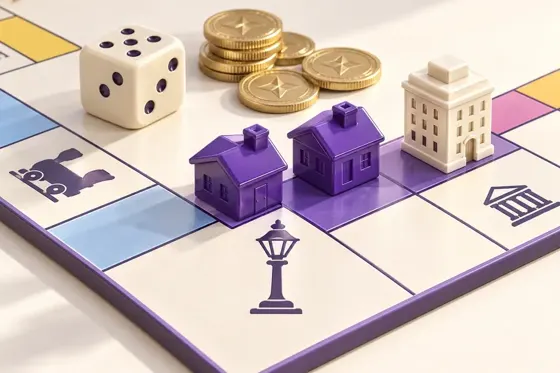
Property Tycoon is a race to remain solvent on a forty-square board of Polish cities. Buy properties, complete colour groups and collect rent, while keeping enough cash for auctions, taxes and an unlucky landing.
Start a game
- Start with 1,500 virtual PLN and choose a piece.
- Roll two dice and follow the destination square’s instructions.
- Buy an unowned property or let it go to auction.
- Complete groups, build evenly and negotiate trades.
- Keep paying your debts. The last solvent player wins.
Money, property and rent
Passing GO pays 200. Landing on an unowned property offers a purchase; landing on an opposing property normally requires rent. A complete colour group doubles the rent on its undeveloped properties.
Stations pay rent of 25, 50, 100 or 200 according to how many the owner holds. Utilities charge four or ten times the dice total. Income tax is 200 and luxury tax is 100. Free Parking has no cash payout.
Auctions and building
An unbought property is auctioned, including when the landing player cannot afford its list price. The highest bid is binding until somebody outbids it. Check your available cash before bidding; do not assume passing leaves the property unowned.
A full colour group allows houses and then a hotel. Build evenly across the group, up to four houses per property before a hotel. The bank’s supply is limited. Mortgaged properties and group restrictions affect what you can build or trade.
Jail and special cards
Three consecutive doubles or Go to Jail send your piece to jail. You can leave by rolling doubles, paying 50 or using a get-out-of-jail card. A third unsuccessful jail roll requires the payment.
Special cards can move pieces or change cash. Read the card and the resulting destination rather than assuming every turn ends after its first landing.
Trading, mortgages and insolvency
A trade can exchange properties and cash, but the recipient must accept. A group containing buildings must be dealt with before its properties can be traded. Taking over a mortgaged property requires a 10% mortgage-transfer payment.
When a debt cannot be paid from cash, the server sells buildings at half price and mortgages eligible properties. If a hotel cannot be broken into houses because the bank lacks stock, the buildings in that group are sold. If the debt still cannot be paid, the player becomes bankrupt and is eliminated.
Example: cash is part of a property’s price
Completing a colour group is attractive, but spending almost every remaining coin can leave you unable to pay the next rent. Compare the purchase or auction bid with your cash reserve and the buildings you can actually afford afterwards.
During an auction, a bid you lead is a commitment. Wait for it to be outbid or resolved rather than treating it as a non-binding expression of interest.
Strategy and useful habits
- Preserve a cash buffer for rent and taxes.
- Compare the value of a complete group with the cost of developing it.
- Read auctions carefully before placing a binding bid.
- Inspect property details to understand rent, building cost and mortgage value.
Common mistakes
- Following an older house rule that unbought properties are never auctioned.
- Expecting a Free Parking jackpot.
- Building unevenly across a colour group.
- Ignoring the cost of taking over a mortgage.
Questions and answers
Are unbought properties auctioned?
Yes. The current game engine includes auctions. Declining or being unable to pay the list price sends the property to auction.
Does the game use real money?
No. The board’s PLN values are virtual game units and cannot be cashed out.
Can I trade with another player?
Yes. You can propose a property-and-cash trade, which the other player must accept.